
BDNF for Neurodiversity: The Powerful Biological Shield for Your Brain
In the modern corporate landscape, “brain fog”, executive dysfunction, and sensory overwhelm are not just personal hurdles. They are biological signals of a mismatched environment. For the neurodivergent professional, leveraging BDNF for Neurodiversity is far more than a physical pursuit; it is a tactical biological strategy that acts as a Pharmacological Intervention without the side effects.
The cornerstone of this intervention is Brain-Derived Neurotrophic Factor (BDNF). Often referred to as “Miracle-Gro” for the brain, BDNF is a protein that supports the survival of existing neurons and encourages the growth of new ones (neurogenesis). For those navigating ADHD, Autism (ASD), Dyslexia, or high-functioning anxiety, understanding how to trigger BDNF for Neurodiversity effectively is the ultimate “bio-hack” for career longevity.

ADHD: Triggering BDNF for Neurodiversity to Support Executive Control
ADHD is characterized by a “low-arousal” frontal cortex and inconsistent dopamine signaling. Exercise acts as a natural primer, preparing the brain for complex cognitive tasks.
- The Science: A seminal meta-analysis published in Psychological Science (Colcombe & Kramer) found that fitness training had the largest impact on Executive Functioning (planning, scheduling, and working memory) compared to other cognitive domains, highlighting the importance of BDNF for Neurodiversity in professional performance.
- The Gender Nuance: Research suggests that hormonal fluctuations (estrogen/progesterone) significantly impact dopamine sensitivity. Strategic Insight: High-estrogen phases may enhance the cognitive benefits of exercise, while low-estrogen phases may require more rhythmic, low-stress movement to avoid cortisol spikes that exacerbate ADHD symptoms.
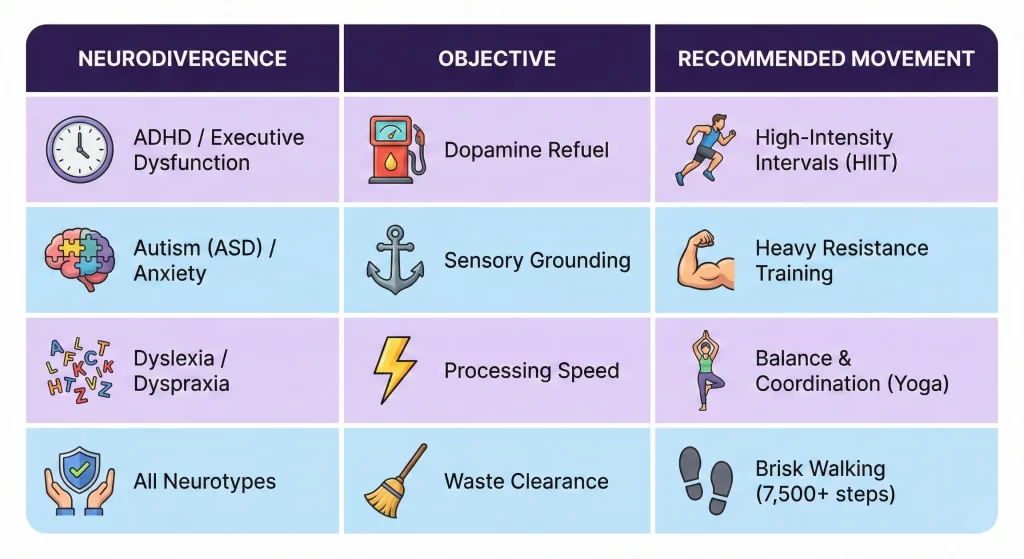
- Recommended Protocol Aerobic + Complexity:
- Exercise: Martial arts, rock climbing, or technical trail running.
- Why: These require the Cerebellum to communicate with the Prefrontal Cortex, reinforcing neural pathways for focus.
Autism (ASD): Using BDNF for Neurodiversity and Sensory Down-Regulation
For the Autistic professional, exercise serves as a tool for proprioceptive input, helping the brain understand the body’s position in space and regulating the nervous system.
- The Science: Research published in PubMed Central regarding the Effects of Physical Exercise on the Stereotyped Behavior of Children with Autism Spectrum disorders indicates that vigorous physical activity can significantly reduce repetitive behaviors (stimming) and improve social responsiveness by regulating the Amygdala’s fear response.
- The Gender Nuance: Autistic females often engage in higher levels of “masking”, which leads to extreme cognitive exhaustion. For these individuals, exercise should be a “low-arousal” sanctuary, ideally in a sensory-controlled environment to prevent burnout.
- Recommended Protocol Steady-State & Resistance:
- Exercise: Heavy weightlifting or swimming.
- Why: The deep pressure of resistance training provides “grounding” sensory input, while swimming offers a muffled, repetitive sensory environment that lowers the HPA-axis stress load.
Dyslexia and Dyspraxia: Structural Connectivity and BDNF
Dyslexia and Dyspraxia are frequently linked to differences in the structural connectivity between brain hemispheres and cerebellar function.
- The Science: A study in Cerebral Cortex (Savic, 2015) suggests that exercise-induced BDNF for Neurodiversity promotes the health of white matter tracts (the brain’s “highways“). Improved white matter integrity helps to speed up the processing of visual and auditory information.
- Recommended Protocol Bilateral Coordination:
- Exercise: Yoga, Tai Chi, or Cross-lateral movements.
- Why: These movements force the left and right hemispheres to communicate, strengthening the Corpus Callosum and improving processing speeds.
The Biological Shield: Clearing “Cognitive Debt” through BDNF for Neurodiversity
Regardless of neurotype, high-stress roles lead to the accumulation of metabolic “exhaust” in the brain.
- The Science: Findings published in Neurology (Hörder et al., 2018) from a 44-year longitudinal study showed that high cardiovascular fitness was associated with an 88% decrease in the risk of dementia. This is largely due to BDNF’s ability to clear Amyloid-Beta proteins (toxic waste) from the brain.
- The Mechanism: Exercise triggers the liver to produce β-hydroxybutyrate, a ketone body that travels to the brain and physically unlocks the “promoter” for the BDNF gene (Sleiman et al., 2016). This biological process is essential for clearing Amyloid-Beta proteins (toxic waste) from the brain.
Conclusion: Implementing BDNF for Neurodiversity Strategy
In a world of distraction, a regulated brain is your most valuable asset. At Sophira Hub, we don’t advocate for “fitness” for the sake of appearance. We advocate for Neural Resilience. By timing your movement to trigger BDNF for Neurodiversity, you aren’t just improving your health, you are safeguarding your ability to think, lead, and innovate.