
Neuro-inclusive Communication: A Powerful Strategy to Optimize Team Performance
For leaders in high-stakes environments, communication is often a minefield of neurological triggers. A misplaced word or a sharp interruption isn’t just a social faux pas; it is a biological threat signal that can shut down the collective intelligence of a room.
Effective leadership communication is not a “soft skill”, it is the strategic management of the interlocutor’s nervous system. By adopting Neuro-inclusive Communication, we move beyond the “aggressive vs. soft” binary and anchor influence in neurobiology.
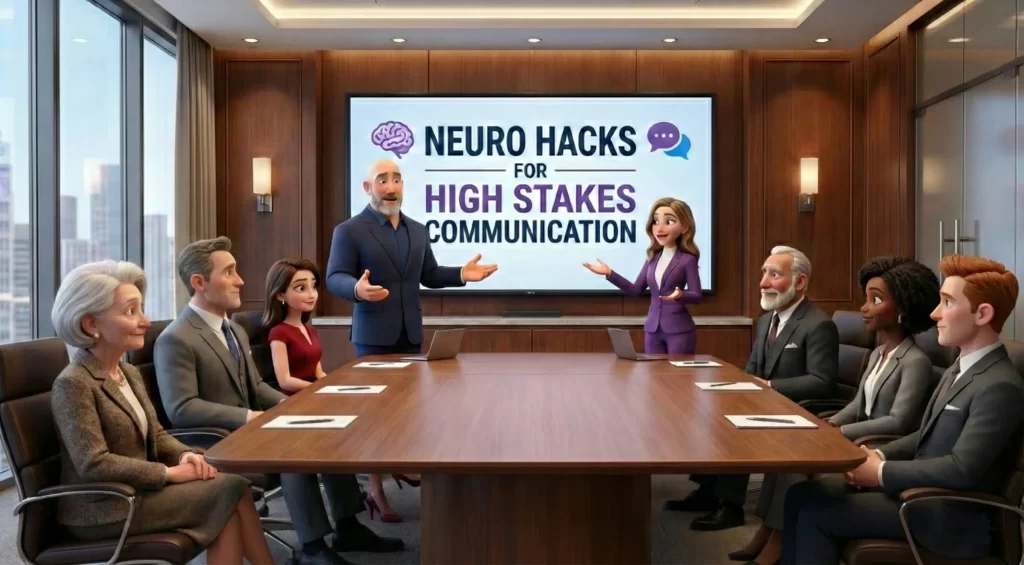
The Neurobiology of Conversation: Connection vs. Threat
Your brain is a social organ, constantly scanning for cues of safety or danger. When communication is optimized through Neuro-inclusive Communication, two key systems stabilize the interaction:
- Neural Coupling & Mirror Neurons: Research in Nature Reviews Neuroscience suggests that during successful communication, the speaker’s and listener’s brains “sync up.” This Neural Coupling creates the foundation for rapport and high-speed trust.
The Neurodivergent Factor: Inclusion as a Communication Standard
A critical gap in corporate High-Impact Communication Strategy is the failure to account for Neurodivergence (ADHD, Autism, AuADHD, amongst others). Standard “professional” social cues are often built on neurotypical expectations, which can inadvertently marginalize some of your most brilliant strategic minds.
 Communicating with ADHD Brains:
- The Challenge: The ADHD brain often struggles with “Interest-Based” nervous systems and executive function delays. Long, meandering monologues can cause their Reticular Activating System (RAS) to disengage.
- The Strategy: Use “Front-Loading.” State the conclusion or the “Why” first.
- Protocol: Provide written agendas in advance to reduce the ‘Working Memory‘ load during the meeting as a core part of your Neuro-inclusive Communication framework.
Communicating with Autistic & AuADHD Brains:
- The Challenge: High-masking Autistic individuals often focus intensely on the literal meaning of words rather than subtext or “office politics.” Vague feedback or “reading between the lines” creates high cognitive load and anxiety.
- The Strategy: Explicit Clarity. Avoid idioms or passive-aggressive hints.
- Protocol: Replace “Let’s touch base soon” with “I will send an email by Tuesday at 4:00 PM with the three specific action items we discussed.“
3 Neuro-Hacks for High-Impact Influence
1. Manage Interruptions with “Calm Firmness”
The Science: When you are interrupted, your brain experiences a “Status Threat.” Reacting with hostility triggers the other person’s Amygdala, leading to a conflict loop.
- The Protocol: Use the “Validate and Reclaim” technique.
- Try This: “I appreciate that point; I’ll be ready to discuss it as soon as I finish this thought.”
- Result: By acknowledging them first (“I appreciate…”), you lower their defensive barriers before reclaiming your verbal territory.
Swap “But” for “And” (The Cognitive Connector)
The Science: The word “but” acts as a cognitive eraser. Neurologically, it signals a contradiction, which can put the listener’s Prefrontal Cortex into a defensive stance. “And” functions as a neural bridge in a High-Impact Communication Strategy.
- Instead of: “Your strategy is solid, but the budget is tight.”
- Try This: “Your strategy is solid, and we need to align the budget to make it viable.”
- Result: This keeps both parties in a “Solution-Seeking” mode rather than a “Rejection-Defense” mode.
Sensory-Aware Communication
The Science: For neurodivergent or highly stressed individuals, environmental noise (bright lights, overlapping voices) creates Sensory Overload, making it biologically impossible to process complex verbal information.
- The Protocol: Implement “Quiet Windows” in high-stakes meetings or use collaborative digital docs to allow for non-verbal contribution, ensuring Neuro-Psychological Safety.
4. Psychological Safety: The Structural Shield
As defined by Dr. Amy Edmondson (Harvard Business School), Psychological Safety is the belief that one will not be punished for speaking up with ideas, questions, or mistakes. In a neuro-inclusive environment, this safety allows neurodivergent leaders to stop Masking (the exhausting process of “acting neurotypical”). When masking stops, the energy previously used for “performing normalcy” is redirected into High-Level Strategy and Innovation.
The Strategic Bottom Line: Optimize, Don’t Just Talk
At Sophira Hub, we help organizations move past communication barriers by applying structural neuro-strategy. Communication is not just about words; it’s about managing the biological energy of your team to prevent burnout and maximize ROI. Partner with Sophira Hub to stop the Brain Drain:
- Communication Audits: Identify “threat triggers” and “sensory bottlenecks” in your organization’s meeting culture.
- Neuro-inclusive Leadership Training: Equip your decision-makers with the tools to foster high-speed trust across diverse neurological profiles using Neuro-inclusive Communication.
- Structural Neuro-Strategy: Optimize interaction patterns to ensure your most valuable human capital stays focused, inclusive, and innovative.